domingo, 16 de abril de 2017

Variants of the Tiger Theater Dance in Mexico

By Óscar Cortés Palma 


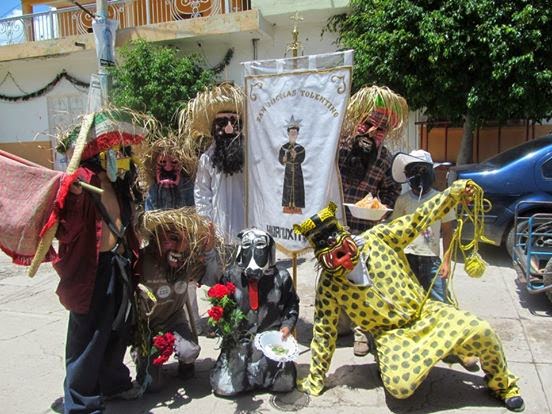
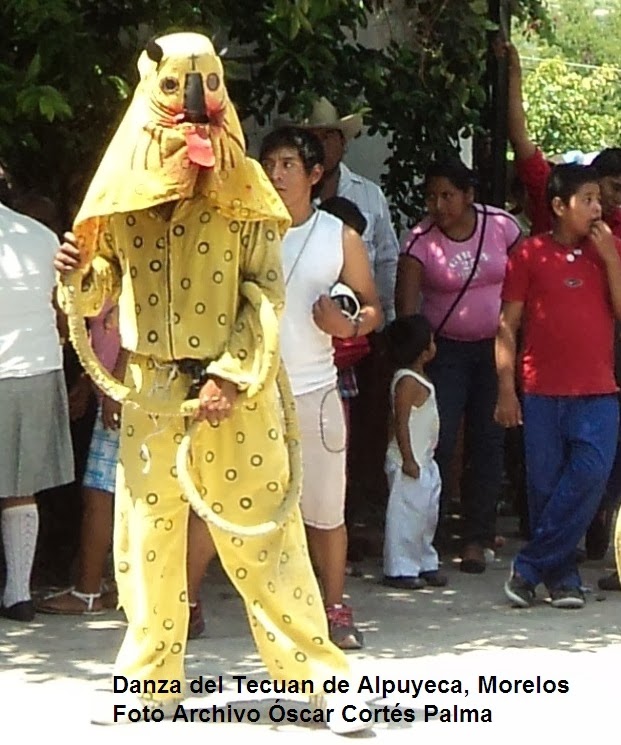
In Mexico dance dances where some of their performers disguise themselves as JAGUARES. Next I present two maps where I show the variants of these Mexican dances. Later a book with this information will be published.


The Jaguars known colloquially as TECUANES or TIGERS are fundamental part of these dances, to the degree that the great majority of them are known like dances of the tecuanes.

 These dances abound in the center-South of Mexico. In this region the scenes of theatrical dances are performed by a dancer disguised as JAGUAR or TECUAN or TIGER.


BOOK OF THE TECUANES JAGUARS


Website: http://danzadelostecuanes.blogspot.mx/
Book of the Tecuanes
Email: cami17_4@hotmail.com; Oscarcortespalma@gmail.com
Facebook.com/oscarcortespalma
Twitter: oscarcortespalm
Traductor de Google para empresas:Google Translator Toolkit


  THE AZTEC CALENDAR AND THE DANCE TEATRO DE TECUANES
 By Óscar Cortés Palma
  

In Axochiapan, a pair of stones with precuauhémémicos symbols are added in one of the frontal walls of the atrium of the church dedicated to Saint Paul the Apostle. One of these stones is so deteriorated that it is very difficult to distinguish its image, but some elderly people of the community comment that previously it could be observed in her a serpent; The other stone is clearly a representation of the Aztec Sun.


It is known, thanks to the book of Elisha Aragon, that these stones have been present since at least the year 1901, when the fence of the church atrium was built, at that time the stones were in the center and from there Moved and were placed in the fence of the atrium of the Church San Pablo, and since then they have remained, since although the fence was remodeled in 1987, it was decided to keep these stones because they are considered part of the history of the city.


There are also legends about these stones, one of them is about the occasion that was tried to relocate them, which was done only for a brief period since many deaths began to occur and some people attributed it to the relocation of the stones, so It was decided to place them again in the fence of the Church's atrium.


The stone of the sun of Axochiapan resembles other stones carved with mexican solar symbols that are found in other places, for example, one is in Huaquechula, a nearby town, but in the state of Puebla and another is in the city of Mexico, and others are found in other parts of the Mexican Republic.

On the stone of the sun of Axochiapan, some specialists like Eduardo Matos Moctezuma, in his book titled "The Aztec calendar and other solar monuments" mentioned that the solar disc carved in the stone of Axochiapan could be a "temalacatl", and is believed That the "temalacatl" were placed in the places recently conquered by the Mexicas.
Another hypothesis could be that this stone represented to the Sun like object of cult for the ancestors of this town. Since the sun has been the vital star that gives us the light, and that makes together with the water and other natural elements that exist life, that is why more than 500 years ago this impressed much to our ancestors, who built many solar monuments , Whose most famous representation is the Stone of the Sun or Aztec calendar that is in the National Museum of Anthropology and History.

Curiously, the Tecuanes (Jaguares) were also related to the Sun in the precuauhteémica time, since 17 of December of 1790, when the called "Aztec Calendar" was discovered.


One of the scholars of the period called Antonio de León y Gama wrote and published an essay titled: "Historical and chronological description of the two stones that on the occasion of the new pavement that is being formed in the main square of Mexico, were found in it The year 1790 ".
Antonio de León y Gama (1735-1802) addressed the subject of this discovery and cited a famous Aztec legend of the creation of the world that says:
"Origin of the sun according to the Mexicans. The sun died four times and there were four suns, the fifth of which was shining, the first lasting 676 years at the end of which men were destroyed, lacking seeds and food, and destroyed by tigers or TECUANES and other ferocious animals; It took the destruction of this sun fifteen years. "

With this information we can realize that for the inhabitants of the city of Mexico of the year of 1790 the word "tecuanes" was not foreign to his vocabulary to them since they defined with this word the tigers, but since in the American continent there was no Tigers, they most likely referred to animals very similar to them: The Jaguars.


This is until now the oldest reference of the Nahua word "tecuanes" and as we can observe it is defined by Antonio de León y Gama in its publication of the year 1790, as tigers or ferocious animals. So it is probable that the traditional dances of the Tecuans and their variants that are currently danced in more than 136 surian towns, in which a "tecuani" participates, are referring by this name to a jaguar, that was of the most ferocious animals of These lands.

 
To finish, if you visit Axochiapan, you can see the Piedra del Sol of this village, which is a circular stone that is 80 centimeters in diameter and 40 centimeters thick. And it is carved only in its front part. Since 1901 it is located on the front wall of the Parish Church of Saint Paul the Apostle, where you can still appreciate the pre-christened symbols of this stone.


Book of the Tecuanes


Book of the Tecuanes

Cel: 7351506920

Email: cami17_4@hotmail.com

Facebook.com/oscarcortespalma
twitter: oscarcortespalm

sábado, 15 de abril de 2017


TRADITIONAL DANCE AND ZAPATISTA REVOLUTION
By Óscar Cortés Palma

As we can see in the map below, the distribution of Dance of Tecuan and similar ones correspond to the same territorial distribution of the Zapatista movement during the Mexican Revolution, in the only places in this region where I have not registered this dance is because they are serranías Or very small rancherías of which we do not know their dances.


In the villages where the Dance of the Tecuan is danced, which I have already mentioned and which corresponds to the territorial strip that is in the boundaries between the states of Morelos, Guerrero, Puebla and Mexico, it is known that since the year of In 1888, the Dance of the Tecuan was danced in the town of Acatlan de Osorio, Puebla brought by "tecuaneros teachers" of some town of nahua filiation; And it is also known that in the town of Tetelpa, municipality of Zacatepec, Morelos, Ramón Sorela already organized the Dance of Tecuan in the year 1895, and is likely to organize it from many years before, so far are the oldest dates That I have about the existence of this dance.


Similarly there are manuscripts that mention the existence of the Tecuan Dance in 1910 in the town of Coatetelco, Morelos and by oral sources we know that before the Mexican revolution was already danced in Axochiapan, Morelos.

From the above I consider that this traditional dance was contemporary to the revolutionary peasants of the 1910s.

The Zapatista outbreak of the 1910s has been well studied, hundreds of books abound on the facts of arms, the political and economic situation during those years, but have not analyzed the culture and traditions of the region where it emerged This peasant rebellion.

He considered that the traditions were and still are essential for the daily life of these communities, for example, the inhabitants of this region invest many economic and human resources in the fairs of their Holy Patrons: stewardships, brotherhoods, traditional dances, Music, large communal meals, ornaments, are strong evidence that traditions must be studied to understand why peasant rebellion has arisen so strongly in this region and not in others.


Unfortunately there is very little literature on the traditional dances of those years, since the government's aim was to make the native settlers abandon their ancestral traditions and adopt the national culture.

But when we study traditional dances today we realize that the traditions are of long or medium historical duration, so it is probable that in the villages where the Dance of the Tecuan is currently danced, they have been dancing for many decades , Because this dance generally describes an aspect of the landlord or latifundista life and at present it has been almost a hundred years since there are no haciendas.


It is more than obvious that there is a relationship between the Dance of the Tecuan and its other dance variants that deal with the hunting of the Jaguar with the territory where the Zapatista rebellion of the 1910s was nurtured, so what I am trying to prove is that This traditional dance and other forms of community organization are a response of these societies to maintain their autonomy and independence, that is to say these traditional dances are related to peasant rebellion of this region probably from before and after to the Mexican Revolution.


I think that in order to understand the Zapatista rebellion, it is necessary to analyze the cultural traditions and networks that exist in the region where it was present, because only then will we explain why the peasant armed movement remained in this region for many years and not in another region.

If we overcome the traditional dance of the Tecuan and other dance variants of the hunting of a Jaguar, with the map of peasant rebellion of the decade of 1910, we will realize that the places where these dances are currently danced with the A region where there were rebellious uprisings before, during and after the Mexican Revolution.


© Óscar Cortés Palma

Book of the Tecuanes

Cel: 7351506920

Email: cami17_4@hotmail.com

Facebook.com/oscarcortespalma

Twitter: oscarcortespalm


Chalcatzingo. Olmec Representations of the Human-Feline Struggle.

By Óscar Cortés Palma

In the eastern region of the state of Morelos, in the municipality of Jantetelco, is located the archaeological zone of Chalcatzingo, a Nahuatl word meaning "native of the small Chalco", this archaeological site was discovered in the mid-1930s and since Then more than 44 pre-Hispanic monuments have been found, whose antiquity oscillates between the years of 800 to 500 BC and correspond to the Olmec civilization.


This archaeological zone is located on the slopes of Cerros Delgado, Ancho and Tenango, visible and recognizable hills from far away, since they are isolated from the other hills of the area, which are few because that region is mainly a plain.

So far four bas-reliefs have been found with figures of felines in this place, one of them represents a feline on a human; Another bas-relief depicts two scenes of two Jaguars attacking two men; In another bas-relief we can observe three felines and in another bas-relief we can observe another feline attacking a human.


MONUMENT 41 OR TRIADA DE LOS FELINOS dated between 800 and 500 BC. This stone is 1.5 meters high and weighs a ton and a half. It has an antiquity of 2,800 years and is located in the Olmec archaeological zone of Chalcatzingo.


The fact that there are many representations of Felines is due to the fact that in the Mesoamerican religions the animals played a main role, in contrast the Christian religions are more humanistic, for example, for the Olmec civilization the Jaguar was the main God.

© Óscar Cortés Palma


Website: http://danzadelostecuanes.blogspot.mx/
Book of the Tecuanes
Cel: 7351506920
Email: cami17_4@hotmail.com; Oscarcortespalma@gmail.com
Facebook.com/oscarcortespalma
Twitter: oscarcortespalm


jueves, 3 de diciembre de 2015

The Jaguar and the rainy season

By Oscar Cortes Palma

Probably the Tecuan or Jaguar was the nagual of the god of rain and fertility to the Olmecs, and it also was for the Aztecs or Mexica, as the God of Rain "Tlaloc" had human-feline features.


To understand this we must first know two things about the naguals:
1. That the naguals for Mesoamerican peoples were wise priests believed they could predict the future, which could bring rain, and at night could turn into animals, plus they were intermediaries of the Gods with humans.
2. That they reached the "Christian" naguals accused of being people "demonic" because their gods to be "Idols" false.


But even before the Spaniards arrived in Mesoamerican religion about priests or Naguales called "Tecuan nahualli" in plural there, "Tecuan Nahuallique" they were called so because these priests preferred to transform into beasts, ie jaguars or cougars, and they abounded in Huaxtecan and in warm earth (the current states of Morelos, Guerrero, Michoacan, a little Edomex).


That's why when the natives saw a Jaguar or Puma on the hill, respected him because apart from fearsome, Jaguar could be the nagual of a powerful priest, or perhaps could be the nagual of a god, like Tezcatlipoca, God crippled with a black stripe on his face who used to become Jaguar since it was a night sorcerer.

But probably the Mesoamerican performed dances and rituals in which a sacrifice Jaguar Nagual was simulated to ask the "showers" and these pre-Hispanic dances are the antecedents of the current Jaguar hunting dances, among which is the Dance the Tecuan, which has very modern elements.

But certainly these dances down more ancient dances to go back to pre-Hispanic times, as we can see clearly that the current Tecuan Dance is an adaptation of an older dance, perhaps the Dance of the Zoyacapoteros extinct or perhaps comes Dance of Chilolos Juxtlahuaca that have traits that senior dance Tecuan or can even arise from the Dance of the Tlacololeros,

This because the Dance of the oldest elements Tlacololeros has, for example, in this dance the hunt of a Jaguar that the crops of peasants eat, something that in our Western mentality seems unlikely depicted as the Jaguars are Carnivores are not herbivores, but this thought is explicable if under another way of understanding the world.
For example, residents of Zitlala and Acatlan, Guerrero currently performed dance and fights Tecuanis, because they think it will be a better time and have a legend that supports this belief, and reads: "Long ago there were two governments in their people, one was a woman named Citlali and another was a man named Acatl, both became "Jaguars Naguales" to steal the seeds Tlaloc was in a giant ant hill and protected by tlaloques.

At that time Tlaloc was upset with humans and would not send the rain and not giving seeds to be born plants, so although the "Jaguars Naguales" managed to steal the seeds to Tlaloc, is the discovered time and as punishment, he became so permanent in Jaguars, and then with lightning and rain made to plunge the hill, and falling to the bottom, the Jaguars watered the seeds that would give humans, then angry and blaming each other for the failure of the mission naguals Jaguars began to fight fiercely and began to bleed heavily.
Human meanwhile, watched the fight closely and notice it was raining and sprouting plants, believed to be due to the fight of the "Jaguars Naguales" and blood pouring from them, then they began to imitate them, and thus year with year when the rainy season approaches, disguised as jaguars and make fights, since they believe that this is pleasing to Tlaloc, and the more blood there will be more rain on their land.


That is, the belief that "Tecuani" or "Jaguar" is the nagual of a ruler, priest or God who sacrifices himself for rain agrees with the ritual fights Tecuanis Zitlala and Acatlan Guerrero, and is also consistent with the Dance of the tlacololeros, because in this dance, the dancers represent growers and natural phenomena related to planting, for example, the characters involved are the "The Maizo" whose name may derive from the word "corn" this is the most senior figure in the dance and who kills the Jaguar or Tecuani; and is also the one who gives the orders to his assistant called "El Salvador" who transmits them to the other characters. "El Salvador" is the second in hierarchy after Maizo, he is the one that goes to Maizo and transmits the instructions and orders of this to "Tlacololero". Also participating:

· "The Tapachero". It is the top seed after the land.
· "The Tecorralero". It is responsible for making the stone corrals
· "The Teyolero". It is who snuggles stone for the Tecorralero build the tecorral.
· "The Jitomatero". It is the sower of tomato, or may represent the plant.
· "The Green Chile". It is the sower of green chile, or may represent the plant.
· "The Gale". It represents the wind that brings rain.
· "The Lightning Dry". It represents the lightning that precedes the rain.
· "The Colmenero". He is collecting honey from the hives.
· "The Frijolero" It is the sower of bean or can represent the plant.
· "The wonder". This character represents the dog accompanying the "Tlacololero" to keep track of the Jaguar.
· "The Tecuani". Jaguar is the harvests of the peasants eat.

All these characters dance so that there is good harvest, as we can see we have the land, represented by "Tlacololero" have land workers represented by the "Tecorralero" we have natural phenomena that attract the rain as "The gale" or the "Lightning Dry" we even vegetables that are going to plant as "The Frijolero" "The Jitomatero", "El Chile Verde", ie everything is almost perfect for a good seed, just missing the main character "The water".


And just as we need the main character we spare a character which is curiously the central character of the dance, I mean the "Tecuani or Jaguar".
So it's not unreasonable to believe that the Jaguar represents the Tlacololeros rain. Because if the Jaguar is no rain, their participation in this Dance time is unclear, since the Jaguars eat meat do not eat crops. Jaguar is the herbivore is not carnivorous.


So if we know that the Dance of the Tlacololeros is to ask for a good harvest, but what role does the "Tecuani" or Jaguar in this dance?

Apparently, researchers on this topic not yet have a convincing answer, I suggest one, we take into account what the legend says about the relationship Zitlala "SACRIFICE" JAGUAR NAGUAL "= RAINS = good harvests." Because, if we find that the character representing a rain dance to ask for good harvest, and noticed the Jaguar appears to have no role in sowing, then why not believe that the Jaguar is the representative of lack "the rain "in the Dance of the Tlacololeros? because just as the rains are the essential part for the good seed, also the Jaguar is the essential character of the Dance of the Tlacololeros, and whether the Jaguar is sacrificed, in a dance that calls for good crops this coincides with the Chronicles of the first friars who arrived in Mesoamerica mentioning that naguales priests blood extracted for ofrendarla their gods, and also when native practiced human sacrifices, performed a ritual in which and sacrificed for a while was dressed as a God and so participating in a dance, as it was believed to be the personification of God.


 In addition, the sacrifice of the gods was nothing foreign to Mesoamerica, there is even a legend about the creation of the world which says that Tezcatlipoca, the mightiest of all God, cut his own foot to throw the sea as bait and lay a Cipactli ambushed a powerful and gigantic sea monster, and so helped by his brother Tezcatlipoca Quetzalcoatl, could eliminate Cipactli and create the world.


Finally, I want to mention that one of the naguales priests who survived the Spanish conquest was Martin Ocelotl, originally from Chinantla, was an influential nagual Tecuan why he was tried by the Inquisition and exiled to Spain but disappeared on the road.


© Oscar Cortes Palma Lic. UNAM and Research in Dance History of Tecuan of Morelos and history of the town of Axochiapan. Email axochiapancultural@hotmail.com; cami17_4@hotmail.com; Facebook: https://www.facebook.com/axochiapan Utilísese educational confines citing the author.

 BOOK OF DANCE Tecuanes


Information obtained from the book Dance of the Tecuanes.
If you wish to purchase this book, please call cel: (045) 735 190 67 62 or send an email to: cami17_4@hotmail.com; or www.facebook.com/OscarCortesPalma

It is a book very well done, has excellent design, finish and content, and very cheap too.

Dances hunt jaguar ". Characteristic of the identity of the "Cultural Suriano Territory".

By Oscar Cortes Palma


To define what it means to be Mexican or Mexican we have to take into account the common cultural behaviors of those who were born in this land we call Mexico.
There are many characteristics that identify us as Mexicans in the world, for example, the typical food, the beautiful costumes, the music of our people, dance and traditional theater and the whole culture we have built as time passes. In other words, we create our own history, our own Mexican identity.


But there are also features that have not taken into account, but that are present and differentiate us from the world. One of them, are the beautiful traditional dances representing a jaguar hunting. All these dances are about eight, I have listed under the name of "theatrical dances jaguar hunting," and are unique in the world. These dances are a symbol of Mexican culture not yet recognized in their proper perspective by intellectuals and by the authorities, but that has not made these dances disappear because it is the people who continues to perform these dances with their own.

The "Dance of the Jaguar hunting" are unique in the world, so they are a cultural characteristic that identifies Mexico from other countries. Because these dances abound in the "Cultural Suriano Territory" which covers the states of Guerrero, Morelos, Puebla and Southern part of the states of Mexico, Michoacan and Oaxaca. So I think that the "Dances hunt Jaguar" give us some elements to understand part of Mexican identity. It is very likely that on Earth there are many dances on the "hunt animals," but have not been studied or have not spread enough, and I must confess I do not know about the existence of "dances representing hunting animals "outside the American continent, but no doubt there are some in the other continents.

However, where we can find many "Dances on hunting animals" is on the American continent, for example in Mexico, in the states of Sonora and Sinaloa, we can find the "Deer Dance" in which hunting is represented a deer.


Further south of Mexico, are about 8 different dances on the "hunt jaguar" in the states of Mexico, Guerrero, Morelos, Puebla, Oaxaca and some in Michoacan. In total there are about 135 Mexican villages where some of the "Dance of the Jaguar hunting" danced. Also in this region are the Cowboys Dance, consisting of the bullfight and death of a bull. Also, a small region in the north between the states of Puebla and Veracruz, in the area was also inhabited by Nahua and tének find the Dance of the Tejoneros consisting of a badger hunting.

But besides Mexico, there are "Dances of hunting animals" in other countries of the American continent, although not as plentiful as in Mexico. For example, in Central America, in the town of San Juan Nonualco, the country of El Salvador, we find the "Dance of the Tiger and the Deer" consisting hunting tiger or jaguar. And in the country of Guatemala dance are dealing Deer hunting this animal.

In South America, there are also dances on hunting of animals such as tiger dance villages of Otare, Mompox and Rio de Oro in Colombia. And in Peru are dance Jaguar hunting in a town called Puerto Maldonado. Also in this country there is another dance called Choq'elas and deals hunting vicuna. In the neighboring country of Ecuador dance are dealing Deer hunting of the animal.

As we can conclude from the above information, the "dances on hunting animals" are not many, and we also realize that most danced in the "Cultural Territory Suriano" in Mexico, but still we have not given the importance to such dances as part of the national identity.


 In other words, dances on hunting animals but mainly the "Dances on the hunt Jaguar" are dances that identify Mexico in the world, in other words, "human-jaguar dancers" are a symbol of regional identity in the south-center of the country, as they are unique globally, so it is necessary to reassess these dances as an Intangible Cultural Heritage of Mexico and the world.

But the "Dance-theater of the hunt Jaguar" also speak for themselves, I mean that if we analyze we offer elements to know as has been the Mexican identity throughout history, to prove this, I will make an example of these dances called "theatrical dance Tecuan". Within these dances are variants. I will analyze one of them: Dance Tecuan Coatetelco type, which is the most danced variant. First the word "Tecuan" or "Tecuani" is of Nahuatl origin and means "something you eat," but that also means fierce, lion, jaguar, tiger, etc.
In this dance involved, at least 17 characters distributed roughly as follows:
17.Pitero
16.Risueño


FILA "A"
FILA "B"
1. Mayeso
2. Salvadorchi
3. Creeping
4. John Shooter
5. Doctor
6. Doctor
7. Flechero
8. Spearman
9. Trapper
10. Yerbero
11.Venado
12. Bitch
13.Zopilote
14. Zopilote
15.Tecuani


As we can see, the characters dance to dance are placed in two parallel rows but three characters, or Pitero Musician, Laughing and Tecuani, who can be located wherever they want. Some of these characters represent trades that existed since colonial times, and some even earlier, and until the 1930s, when land reform was in Mexico. For instance:
1. Salvadorchi is the landowner who has a lot of land, money and cattle.
2. Mayeso Squire's assistant, which is transmitted orders Salvadorchi their workers.
3. John Puller is a person whose job is to hunt animals with their firearm.
4. Creeping is a person who is dedicated to track wild animals, for that accompany their dogs.
5. Doctors have as trade heal people

6. Flechero has as trade, engage in the hunt using bow and arrow
7. The Lancer has as trade, engage in the hunt using spears
8. Yerbero is a warlock magic frightened by the "evil".
9. The Trapper is a person skilled in setting traps.
10. The deer is a native animal of the Mexican fauna, relatively abundant and is hunted as food.
11. Bitches are very common animal in Mexico
12. Vultures are carrion birds originating from Mexico.

13. Laughing is a silent hermit walks laughing like crazy, thus the name, and lives in the mountains, but thanks to his knowledge of the hill to catch the Tecuani works.

These characters participate in traditional dance Tecuan, whose plot tells the struggle between a wealthy landowner against a jaguar that is threatening their cattle. Squire, orders his assistant to hunt for the beast, but as his assistant can not, then hire expert hunters hunt the jaguar finally called Tecuan or Tecuani.


This variant of the dance Tecuan is currently dancing in more than 45 villages, and through this dance we know a part of the "Mexican identity", for example thanks to this dance we know that in Mexico there existed and ranches and estates livestock; and there and there were jaguars. Likewise through this dance we know that in Mexico earlier in rural areas had some different trades today. For example there were shooters, trappers, trackers of wildlife. We also know that the bow and arrow with spear guns were used by our ancestors, like the grass to scare some "evil". We also know that deer, vultures and dogs are animals accompanied the Mexicans since ancient times.

In conclusion the "Dance of the Jaguar Hunt" are fundamental symbols of Mexican identity, that abound in this country and are old. They even have pre-Hispanic elements because animals originating involved; besides this traditional dance it has been dancing for over hundred years ago. Landowner tells the treasury and life, one of the most dominant economic activities during the colonial period and even years after the Mexican Revolution.

These "Dances theater Jaguar Hunt" our ancestors created them because they wanted to tell us something. They wanted to tell a story, and as they spoke Nahuatl, and most could not read or write, we told their story through dance and popular theater, and the message has reached our days.

Which is surprising because it's been almost 100 years since disappeared many of the elements that tells the theatrical dance Tecuan, for example, the "power relations" between the farmer and his workers to catch the Jaguar, and almost as There are no trades that describes this dance, which nevertheless remains traditionally represented at fairs around 77 Mexican towns.


So I think it is necessary that the "Dances hunt Jaguar" are taken into account as an important part of national identity. Al revalorarlas we know symbols of the current Mexican identity and how it has changed the Mexican identity throughout history, as the theatrical dance Tecuan tells us part of our history, plus the traditional theatrical dance has been making the Mexican settlers with their own economic and human resources and generally do not receive institutional support.


© Oscar Cortes Palma Lic. UNAM and Research in Dance History of Tecuan of Morelos and history of the town of Axochiapan. Email axochiapancultural@hotmail.com; cami17_4@hotmail.com; Facebook: https://www.facebook.com/oscarcortespalma


 BOOK OF DANCE Tecuanes


Information obtained from the book Dance of the Tecuanes.
If you wish to purchase this book, please call cel: (045) 735 190 67 62 or send an email to: cami17_4@hotmail.com; or www.facebook.com/OscarCortesPalma

It is a book very well done, has excellent design, finish and content, and very cheap too.